Custom Link Bar

Showing posts with label Toby Fox. Show all posts

27.11.18

Still Dreaming, Still Deafening
(22 in Review)

Another year and still no release.

In last year's update I mentioned my dismay stemming from a lack of progress in releasing a demo for The Valentine Watch. As such, you can only imagine my frustration knowing that it's still not released. Every time I draft a seemingly-sensible schedule for its development, it always seems like its completion is just around the corner; only a handful of months away at best. Initially, these plans appear to hold true and I catch faint glimpses of the finish line. However as I grow comfortable with the rate of progress, unforeseen issues and underestimations inevitably take hold and wreak havoc, crushing my expectations and faltering my motivation and discipline in the process.

This marathon of a grind has been a ferocious battle of attrition; a seemingly never-ending cycle of rescheduling and reiteration. Back in June (now already half a year ago) it was around one year since I had graduated from university. It made me realise how little had changed in the time since departing: still at home, still no real income, still no game. No real change other than an extra year tallied onto my age. In many ways I think this has been my bleakest year and it leaves me anxious whilst dreaming of the future-- I really can't see myself looking back fondly on this chapter of my life, even if there's not much worthy of remembrance.

Now that's not to say it was a complete loss. I did manage to secure some grants and take steps towards turning this game- and career by extension- into an actual business entity: I secured a little under £10,000 in funding; I made my first trip to a games expo; I registered myself as a sole trader.

Even the game seems to be reaching some sort of milestone: this past month I finished writing the first draft of the demo's script, the first draft of the trailer, as well as taking steps to conclude the programming side of development. Once again, a demo release seems well within reach. I hesitate to announce a date but I know it's coming soon, I can feel it in my bones. I just need to delve a little further, a little deeper into this deafening chasm I find myself in.


◇◆◇


Games
Unfortunately this year has also been entirely devoid of games. Aside from my own, I don't think I've spent more than thirty hours playing anything at all this past year.

Just like the last, I've found it incredibly difficult to find anything worth playing-- very few of the games I stumbled across seemed all that alluring. However that's not to say that there were none whatsoever-- my lack of enthusiasm meant that I rarely searched for the new and obscure so I'm hopeful that there are at least some hidden gems that have simply flown beneath my radar. But from what I did see, I found games like Red Dead Redemption 2 to be very fascinating. That said, I would still be hard-pressed to justify the cost of a new console based on it alone (as well as the current state of my bank balance).

For the first half of the year I continued to spend time (albeit less frequently) playing Melee and attending the occasional local tournament. However in the space of a few months I broke two controllers and lacked the motivation to buy another. This is something I still haven't done, despite enjoying the game. And I still haven't played Melee since, thanks to this lethargy.

It looked like I was going to complete the year without finishing anything new. If it wasn't for Toby Fox's surprise release, Deltarune, that sadly would have been the case. I was very excited to play it-- I consider Toby a major inspiration of mine (honestly, the development/release cycle of Undertale appears to be the best possible outcome for a solo indie dev) and I was expecting to have mounds to write by the time it was all over.

I didn't realise it was just a demo so I was more than a little disappointed when I reached the end of the experience. However, even after taken that into account I feel like the core narrative was rather underwhelming.

Everything started off so strong: I thought the opening character creation sequence was rather devious and set up an interesting concept for the narrative to explore. However, it felt like the idea was dropped the moment the intro sequence was over. Yes, while you had no 'choice' in the story, there was never a point where you felt like the lack of choice or agency really mattered in the grand scheme of things-- everything always turned out alright in the end.

I was also a little disappointed to see him resort to recycling characters from Undertale. At first I thought there was some significance to this, like the fact that the game starts almost as if it's a direct sequel to it. But then once again all of these ideas were dropped as soon as their use had expired: there is nothing more to read in their inclusion. Even Toby seemed to suggest as much on his Twitter. But if that's the case, then what's the point? It's not just the characters either-- so much of the game seems to draw parallels to Undertale. I mean, look at the structure: child(ren) falls into an unknown underground society and must search for a means of escape. A goat helps guide them as they come to terms with this foreign land. Along the way, a '''villain''' tries to capture them and prevent them from escaping. Through repeated encounters (via puzzles and battles) we learn that they are in fact harmless (and humorous) and are given a chance to befriend them.

While it seems harsh to assume his intentions when it is just a work in progress, to me it felt as though he was trying to capitalise on the strength of these previous concepts without the willingness to handle any of their baggage.

And the worst thing is is that I found all the new characters to be charming-- the interactions between the main trio were particularly delightful. I just wish the game diverged more from the previous or at the very least tried to reconcile some of its ideas.

While it's true that this is only a demo and we don't really know what's planned I still don't think it's productive to keep quiet about these reservations. Even now, a big part of me thinks that this is one big ruse, and that Toby has intentionally created these false pretenses to lure us into the big twist in the finished game. I have absolute faith in his ability to do so, perhaps more so than any other game developer. There were plenty of upgrades to Deltarune that show he has the skills: the new combat system (and its beautiful, beautiful animations), the new character designs, even the lighting in some sections seemed a cut above:


Apparently it took him an exhausting three years to make this demo (boy, I can relate to that) so the full release is still a little off. Despite that, and whatever criticism I have just made, this game is one that I am really, really, looking forward to.

I wonder what will be completed first: Deltarune or The Valentine Watch...


Film
Following this trend, my consumption of films has also waned. With every passing year, worthwhile movies seems harder and harder to find. Very few releases have compelled me to attend a screening and I've almost entirely stopped watching streams. All I seem to watch now is the same old Adam Curtis docs I've seen a hundred times.

I went to the same film festival this year and found it rather disappointing when compared to the last. I don't know if 2017 was a particularly strong year or what, but my time felt wasted by the bulk of the screenings this time around. The only highlight was An Elephant Sitting Still, a four-hour flick from China. The film was a bit of a grind, not just because of its length but also due its slow, methodical pacing. Despite that, there are a lot of scenes that stick in my mind after all this time.


The only other standout film I saw at the cinema this year was Shoplifters by Hirokazu Koreeda. It is by far my favourite film made by him, and probably my best experience in a theatre since Tokyo Godfathers over a year ago.

However, the most important film (or perhaps any piece of art, period) that I saw this year was No Game No Life Zero, of all things.


This was a complete surprise. This past year I've really fallen out of favour with anime. One night after returning from the gym I decided to search for a film to help me fall asleep. By sheer chance I found this gem. I vaguely remember watching the TV series many years ago and somewhat enjoying it. So why not give this a go?

I was very close to switching it off while watching: it was filled with your typical, by-the-book anime tropes, vanilla animation, and a bog-standard post-apocalyptic storyline to fill-in the gaps. Some scenes seemed laughably poor. I even had to pause the video on routine to fill myself in on all the crucial lore needed to appreciate the scenes and characters. Despite these frustrations, I persisted and watched it through to the end. I thought it was pretty alright. I fell asleep soon after.

The next day, the film was still on my mind so I decided to re-watch it. The same flurry of thoughts lingered through to the next day after that so I watched it yet again for a third time. After that, I binged the original series all over again with newfound appreciation. Soon after I watched all the obscure OVAs and extras associated with the series.

I had fallen in love with the film. For about two weeks it was constantly plaguing my mind, robbing me of entire days of productivity. Even though I had exhausted all forms of its content I desperately hunted for more: discussions, fan-art, figurines,...

Without a doubt, this is the most obsessed I have been with a film or franchise since I was a teen. However, even with all of this unfettered adoration I was still keenly aware of how awkward and unbalanced the film was. I was convinced that this was my favourite thing ever, even if the bulk of it was bad.

For whatever reason, the second half of the film resonated with me so strongly as to make the first half effectively irrelevant in my enjoyment of the whole. Even now, I'm not entirely sure why exactly it affected me so much.

If I tried to explain it, I think it has to do with the 'slow murder' of the main character during the climax. A heart-rending, gut-wrenching demise made all the worse by the fact that you knew she was doomed to perish from the outset. The music in this scene is phenomenal and lends the tragedy an 'operatic' flair.

Up until this point, my ideas of art in general were very pretentious, to put it lightly; I was very, very critical of shilling through art. The fact that I fell in love with this film forced me to rethink my perspective and shake-off this juvenile arrogance that was at the heart of my philosophy. The film was obviously produced with the intent to extract wealth from the Otaku invested in the original. The amount of merchandise is overwhelming: figures, posters, collector's editions, you name it. This film was made with profit in mind, not some higher, nobler cause, whatever that means. But even if that's the case, does that really matter if I loved it?

I haven't watched it again since my binge, though I really want to. While my wild obsession with the franchise quickly died down my curiosity remains dormant. The subtitles in the version I watched were very questionable so I've been waiting for a polished blu-ray release. While I'm a little scared that this re-watch will tarnish the grand idea I have of this film in my mind, I'm intrigued to see how my feelings hold after all this time. The blu-ray was just recently released in the UK so I guess we'll find out soon.


Music

LAVA|OX|SEA

LAVA|OX|SEA !!!


LAVA|OX|SEA !!!!!!!!!


What a band! Soon after writing last year's review I stumbled upon the band's entire discography and fell in love. I had been well aware of this band for a number of years (even mentioning them in last year's update) but I struggled to find much of the band's works: only a handful of their songs were available on YouTube. But the tracks that I could find were all great, cultivating a distinctive tone that aligned seamlessly with my own predilections. However, because there were so few I never felt like I had the opportunity to truly immerse myself within their sound. For the longest time, I was under the impression that this tiny catalogue was all that existed of this peculiar band. However, after stumbling across the band's RateYourMusic profile I discovered that I had barely scratched the surface-- entire album's worth of material was listed so I soon went on a hunt to find these missing tapes. Where it was remained a mystery, but I knew that if was to find any more, I would have to dig deep.

After a few nights of investigation, I found a site called Xiami, which can best be described as a Chinese Spotify. Here, I found all of their albums as well as other obscure tracks belonging to other similarly-obscure artists.

I find it hard to describe what exactly draws me to this band-- even their genre is hard to pinpoint. If I had to say, I would describe their appeal as something much more fundamental, embedded within their seemingly-unique approach to music. This flavour can be felt through each of their albums even though the resultant sound of each remains incredibly distinctive: ultra lo-fi indie tapes in Media Murdered the Young to violent and thrashy rock affairs in Heavy Metal Rock is the Best Music (please note that this album is anything but heavy metal).


Despite their major differences, all of their albums maintain a high benchmark and I would struggle to single out any of them as the best. Equally, none of them are flawless, as each album possesses its own unique faults.

Sadly the band disbanded several years ago so it's unlikely that we will ever see another release. While the frontman/guitarist Han-Han has performed in a handful of acts previous to and since LAVA|OX|SEA (Lowspirit, Duck Fight Goose, GOOOOOSE), they largely fail to fill the gap-- while faint familiar flavours can be felt here and there, it's simply not the same. Thankfully I haven't exhausted the band's four albums just yet so the panic can hold off, at least for now.

This past year, I've also been delving into classical. Initially this was done as an exercise to boost my knowledge of the genre as the soundtrack for The Valentine Watch will be comprised of arrangements from that era. However, slowly but surely, this venture transformed into a leisure as I found more pockets of interest within the field. I had never really taken interest in classical music outside of a handful of compositions (Gymnopédies, Danse Macabre) but today I find myself with a broad range of interests in the genre, both old and new.

This process was kickstarted by my discovery of Janis Crunch's album, I Just Love the Piano. I was drawn to this collection after hearing the track Rob Call. To this day it remains my favourite piano piece and one of my favourite songs ever:


A live version of the song. Check out the version on 'Casa' if you can!

Before this album, I never thought I'd be able to tolerate a full-length LP comprised almost exclusively of piano. Needless to say, this album changed that. Not only has it become one of my favourites, it has also given me the desire to learn piano (or at the very least, the aforementioned song).

From there, my prejudices towards the genre shrank and I began to delve further into the music. I now love Rachmaninov (The Isle of the Dead) and Ravel (Pavane for a Dead Princess, A Boat on the Ocean) and I'm sure there's plenty more out there for me to discover.

This past year my love for The Cinematic Orchestra has also reignited. Initially, I discovered them back in high school through their album Everyday. However during my time at university I began to fall out of favour with them and they receded to the back of my mind before fading entirely. Over Summer I rediscovered them, and this time went on to explore their entire discography. Similar to LAVA|OX|SEA, each album caters to a different itch while maintaining a high-level of excellence. I'm glad to have found them again.

Other than that, my obscure-hipster-Asian rock tastes have also developed and I am now listening to bands like Scarlet's Other Parts, Butterbeer, and The White Tulips.


Art
Unfortunately my exploration of art has also stagnated this year: I've lacked the opportunity to explore any new galleries recently so I've often had to resort to retreading through the same old lot. I'd really need to visit new cities and new countries if I'm to find anything refreshing at this point. As such, I haven't really had the chance to develop my tastes: things are more or less looking the same as they were a year ago.

That said, I have been attending life drawing sessions again after stopping for six months. While I'm not 100% happy with where I am now, I am comfortable enough to share some of my sketches:


I'm going to continue sketching for the foreseeable future although I would really like to delve into painting, particularly oil. Maybe I'll be able to show you all some next year.


Manga / Comics
I've been reading a tonne of manga this year. While my exploration of most other mediums could be described as sluggish, my interest in manga has been thoroughly rejuvenated. At this point it may even be the medium that I have consumed the most of, or at the very least, the most frequently.

As a young teen I used to read chapters every other day. While I preferred anime, their awkward broadcast schedules coupled with a lack of adequate streaming sites meant that it was too frustrating and too out of reach for casual enjoyment. Manga provided a cheaper, more readily available alternative for accessing the subculture. Every week I could look forward to a batch of new chapters from all of my favourite series. Now I don't remember reading anything particularly noteworthy from that time; I'm sure it was just the usual weeb staples like Naruto, Death Note, and Gantz.

However, as internet speeds rocketed and streaming sites improved my focus shifted back to anime. I only read manga in the cases where I could follow the story further than their respective anime (like in the case of Tokyo Ghoul and Hunter x Hunter).

It wasn't until last year that my patience for anime began to wear. Once again, I shifted back to manga and I was immediately caught off-guard by the diversity and variety on offer, especially when compared to anime: narrative, tone, aesthetic,... there was so much more to see and it all felt much more deliberate. I dug in, first sinking my teeth into shorter titles like Downfall and Mujirushi.

I would like to gush about all the fantastic series I've read this past year but there are simply too many.

I love BLAME! for its utterly bleak portrait of our future; I love Golden Kamuy for its humorous and intriguing caper in an interesting era; I love Dorohedoro for its scratchy, punk aesthetic and its dark twisted humour; I love ReLIFE for its sweet charm and captivating conceit; I love Memories of Emanon for its beautiful yet bittersweet take on a single night's encounter and the painful longing that comes thereafter.


I'm really glad I've delved back into manga. For once, I have no fear that I'm going to run the supply dry, at least for this coming year-- there is simply too much that I still need to read. I've barely scratched the surface with Inio Asano or Naoki Urusawa and I still have the conclusions of Attack on Titan, Hunter x Hunter, and Golden Kamuy to enjoy. Plenty to look forward too!


Books & Literature
Lastly, I wanted to briefly mention my recent appreciation for novels. It has finally clicked! For most of my life I've had very little motivation when it comes to reading even though I knew that it was something I really had to do if I was to improve as a creator: how else could I increase my proficiency in writing if I did not read? For me, I think the issue lied with the fact that I found it immensely difficult to find books with stories that I would take interest in. However, whenever I did unearth a sliver of interest in books it always came in a burst, usually after finding a cluster of stories that matched my sensibilities for the time: fantastical epics with The Iliad and The Odyssey, dystopian futures with 1984 and Brave New World.

However in these cases I would find it difficult to find the next novel once I had exhausted the most obvious and natural progression. It was also tiring to read the same niche genre over and over again. As such, I could never extend my interest beyond a handful of books at a time.

In recent months however, things have turned and I think I can finally say that I've found my favourite author, Osamu Dazai:


I picked up his final novel, No Longer Human, back in August and immediately fell in love. While that may not be the most apt expression to use when discussing a novel about alienation, drug abuse, depression, and suicide, I found it strangely touching and resonating.

His earlier novel, The Setting Sun was just as beautiful and unsettling. It is the first book that I've read where specific passages have hit me like a tonne of bricks, searing their words into my mind in the process:

"Whenever you can hear the gloomy sighs of woe from the four walls around you, you know there's not a chance of happiness existing just for you. What feelings do you suppose a man has when he realises that he will never know happiness or glory as long as he lives? Hard work. All that amounts to is food for the wild beasts of hunger. There are too many pitiful people."

I'm currently reading Fahrenheit 451 and I think I might also start Spring Snow soon, marking the first time I've read two books in tandem.

I'm glad things seem to be finally clicking. It is still very much a new hobby of mine so I cannot definitively say I have a top 10 yet (I think I would struggle to even name ten novels). However I hope that my interest continues to blossom over the course of this coming year. Maybe I'll have a 3x3 for next time.


[  ] [  ] [  ]
[  ] [  ] [  ]
[  ] [  ] [  ]


Final Remark
In many ways, the 'highlights' of this past year have been experiences through fiction, whether it's film, manga, music or other. Hopefully this isn't a prelude to the new norm expected in adult life, but rather a transitional phase after the freefall I've found myself in since graduating.

It has largely been an uneventful year, grinding away for hours upon hours trying to realise this project. I feel ineffectual and incapable much of the time but what determination is left is firmly set on seeing this project to completion in some form; whether that is just a demo or something more remains to be seen, however. While I have been saying for months- probably even years- that the demo is right round the corner I can now feel it in my bones. Not much longer to go.

Now to prevent this post from diving straight off into the deep-end of depression I should point out that this year hasn't been a complete loss-- there have of course been some high points. Just over a week ago I went to my first music concert in years, seeing Tricot in Glasgow. It's not much, but I found the whole experience to be astounding. What a band! They are quite possibly the coolest people I have ever witnessed. If there is only a single day from this year that I look back fondly on, I'm sure it will be that. Hopefully there will be many more days just like it right around the corner.


◇◆◇


P.S.
For all those keeping score, the old iPhone is still functioning. It will be turning 9 years old next month.

29.1.18

Difficulty is not an Option

There has been a lot of hubbub in recent months surrounding the concept of difficulty in games: can games be too hard? Can they be too easy? Should the player be able to regulate their difficulty? This topic is nothing new within the community: it has reemerged time and time again, unearthing itself alongside the release of some new game that disrespects the player for picking less-challenging difficulties1, or introducing some novel method of regulating difficulty2, or perhaps the absence of any difficulty settings at all3. Within each iteration of this debate the same two factions arise. The first group could be roughly classified as 'classical gamers' and are typically against all design features that diminish the intended challenge of a game. Their beliefs staunchly oppose the proliferation of features that promote design elements such as 'hand-holding' and 'rubber-banding'. In their view, these features diminish the level of challenge with a game, so much so in some cases that the act of completing them no longer feels like an achievement. And what is a game without any challenge or achievement? Conversely, the opposition is composed of players who believe that a game's purpose is to provide the player with 'fun', or more loosely, entertainment. Simplistically speaking, their position is concerned with making games as accessible as possible to its player base-- if a game is turning away players in frustration due to its design or due to its challenge, then the developer has failed to make an entertaining, and therefore worthwhile game.


With each iteration of these arguments, the community never reaches any sort of consensus; the arguments typically boil down to whether the focus of a game should be to provide a challenge or to entertain the player as much as possible. For classical gamers these two ideas may be one and the same (and its the synthesis of these two attributes that makes a game a game). For many others however these motives could not be any more diametrically opposed. However, the ideas being discussed at the root of this debate are completely misguided. Instead of arguing whether or not games are too easy or too difficult we should be asking why games don't provide any meaningful narrative insight when the player fails-- player failure is rarely incorporated into the narrative despite it being a fundamental part of the experience for almost all playthroughs in any game.

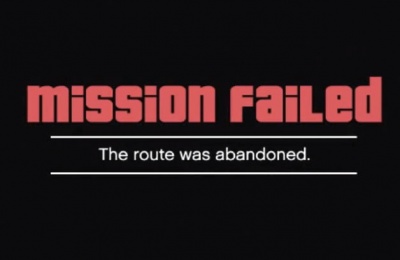
GTA V

'Player failure' is a situation in which the player has failed to achieve something expected of them by the game. This can be caused by a broad range of factors depending on the type of game: falling off a stage in a platformer, losing all your health in a shoot 'em up, or even failing a mission objective in a first person shooter. In most cases a player failure results in some kind of 'fail-state': a situation in which the player cannot progress any further and must retry the sequence again. Essentially a GAME OVER or MISSION FAILED screen (see image above). During this process the player is whisked back to some previous position before the failure occurred, typically incurring some sort of quantitative penalty in the process: coins, points, lives, souls, etc. Apart from these small penalties, the existence of the failure is typically forgotten by the game: it is treated as an unwanted mistake and is erased from the experience without a trace, never to be seen again. This is the problem with games, not how easy or hard they are.


It is these kinds of situations where the player has failed to achieve their role that the game (and the developer by extension) should have a profound interest in. So long as it wasn't a bug-related issue, the reason for the player's failure is due to the player themselves. It should be within the developer's interest to contextualise the player's failure within the experience they are trying to tell, not to simply discard it. What does it mean to have failed saving the princess? Failed to save a hostage? Failed to escape the dungeon? If these situations are all possible within the game, the narrative should have an answer for them.


It is important to make the distinction between two types of player failure: mechanical and narrative. While there should be significant overlap between the two4, it is important to highlight the difference and how each uniquely affects the player's experience. Mechanical failure is due to the player failing to use the game's mechanics to solve the problem given to them. This 'problem' could be a level in a platformer, an enemy in a fighter, or a puzzle in a puzzler. Failure in such systems is usually caused by the player's lack of understanding or misapplication of a particular mechanic or system. Mechanical failure varies from game to game, but the rules that govern them are explicit within the design: falling off the stage, losing all your health, reaching an unwinnable state in a puzzle. In such situations, some sort of 'reset' is required to pull the player out of their position as progress can no longer be made-- you can't progress through a level any more if you have fallen off of all the platforms. Resetting the game allows for the player to revise their tactics and experiment, over and over, plugging gaps in their knowledge and boosting their understanding of the systems in play. After an indeterminate amount of time you would expect the player to be able to reach a level of understanding where they can now complete the problem that they previously failed. This 'trial and error' approach forms the fundamental backbone of almost all games as well as the primary tenet of the classical gamers' philosophy.


Now on the other hand, a narrative failure exists when the player fails to do something expected of them by the narrative-- failing to aid a character, failing to track a suspect, killing an ally and so forth. These are objectives that are not explicit within the games rules-- they are expressed solely through the narrative and are present only as long as the narrative requires it. These additional rules are forced into a game because the narrative created ceases to function when unexpected actions are made: you cannot save the man we asked you to kill. You cannot betray your allies. You must save the princess. Deviating from the expected path is treated as a fail-state only because it breaks these additional narrative rules used to safeguard the plot. As ridiculous as it may sound, why do games need to rely on these additional rules solely for narrative cohesion? Why are actions that are mechanically sound within the universe considered fail-states solely due narrative concerns? It is entirely possible for the game to continue despite the narrative failure committed by the player, yet it chooses not to.


Narrative failures arise from a game narrative that consciously limits the set of actions permissible within the game's systems.


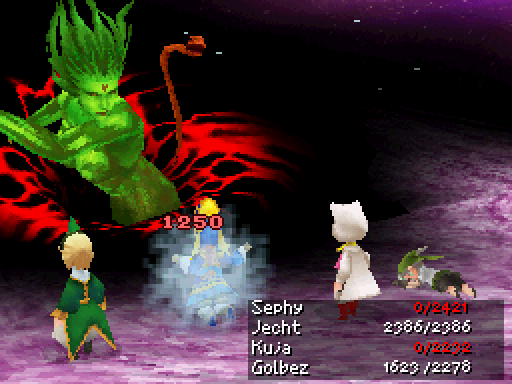
To put it into other words, narrative failures are a result of a narrative being imposed on game systems that it is unfit to serve. When the narrative was written it didn't take into account all the options available to the player through the game's design. Or even worse, the writers decided that certain types of play were simply 'wrong', despite them being mechanically sound. This refusal to handle any situation other than what is deemed 'normative behaviour' has stifled games' ability to tell anything meaningful that exists outside of what is desired. This aversion reaches the point of absurdity where some games5 have situations in which you are forced to lose to a certain enemy. Unbeknownst to the player, the rules for succeeding and failing have been swapped for this scenario. Now what is this warped situation supposed to convey? The player is left in confusion; the game has suddenly decided that failure is desirable, but only when it wants it to. This situation also creates dissonance in future playthroughs where the player, having knowledge of this scenario, realises it is in their best interest to stop resisting and allow these enemies to defeat you, breaking the role of their character.

The first encounter with the Cloud of Darkness in FFIII is one such instance of an unwinnable fight

We reach such absurd scenarios when we treat narrative failures no differently than mechanical failures. While a fail-state is adequate, perhaps even necessary, for mechanical failures, this is certainly not true for narrative failures. The difference lies in causality. With the mechanics of the game, it should be clear to the player (so long as they understand the systems) exactly why and how they failed: they missed a jump, they took too much damage, they finished the race last. Not only is it clear why they died, but also how they can prevent the failure from happening again: a more precise jump, taking less hits, making quicker laps. The same reasoning cannot be applied to narrative failures. Both the problem and the solution are only outlined within the narrative as much as it sees fit, sometimes surfacing only after the problem has been solved. There is also room for interpretation within each narrative as it's not always clear what you are supposed to do or how you are supposed to achieve it. Videos games are an interactive medium so why do we so rarely see games interacting with these different interpretations instead of disregarding them as another fail-state?


Here is a hypothetical situation. Imagine you play the role of a super-patriotic-almost-propaganda soldier sent on missions across the world with your team to combat terror. Your typical first-person shooter fanfare. So what happens if you decide to go against your orders and spare an enemy? Such an action would go against everything the game expects and wants you to do. In most games you would just be thrown into a fail-state and forced to restart the mission once you miss your opportunity. However this doesn't teach the player anything or allow them to interact with the narrative in any way-- their protest to the game's narrative ideals are left unchallenged and ignored so the player is left with nothing to do other than to shrug their shoulders and blindly follow the mission's orders without gaining any insight or consequence: the player is torn away from their role as a driving influence within the world and is instead forced into a much more passive role, one where their only choice is to follow the game's authority.


Instead of forbidding the player from acting freely, the game should allow the player to carry out their actions and then respond by shaping the narrative in a way that shows the player why their actions are wrong. The player should be convinced that they want to be the hero; they shouldn't be forced into the role. One such way of doing this is by providing a means for the player to face the consequences of their actions. Guilt could be produced by linking the player's 'incorrect' decision to new dire circumstances that emerge in the narrative: perhaps the target that the soldier spared goes on to kill the protagonist's allies in later missions. With the narrative irrevocably shifted in a negative direction, the player is constantly reminded of their failure. They may even regret their decision. Regardless of how they feel, a stain has been left on their experience. In such situations, players who fail (whether by choice or inability) still progress, but along a different path from the successful players. This alternate direction gives the players the opportunity to understand why their actions were treated as a failure. If the game is successful in their conviction, the player is going to be compelled to succeed in the future according to the narrative's own ideals, just like the other players who succeeded.


A practical example of this is the opening act of Undertale. Here, the developer Toby Fox managed to eliminate all forms of narrative-induced fail-states-- all narrative failures are accounted for within the game's narrative. In this scene, the player is introduced to Toriel, a mother-like figure who protects and cares for the protagonist after they fall into the underground. The protagonist's desire to escape the underground means that they have to venture deeper into it, putting themselves in greater danger-- something that Toriel is actively against. This is the source of the conflict: the player is pitted against their friend and the only way they can seemingly progress is by defeating her. However, to defeat her would mean killing her. The player is ofcourse not expected to make this choice. The narrative makes it clear that it wants you to save her-- the game has told you time and time again that "nobody needs to die". The player has probably spared previous enemies from death too, giving credence to this mantra. However, the way the player can spare these character's from death is unknown. This is the problem that the game wants you to solve.


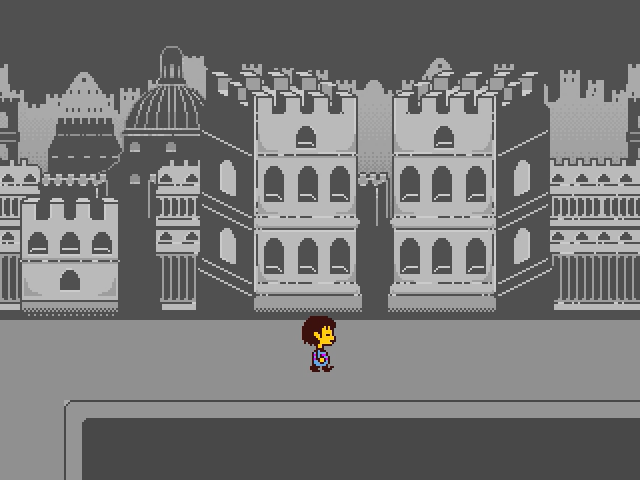
In this example we have one mechanical failure and one narrative failure: losing all your health and dying, and killing Toriel. Now, in a traditionally-designed game, both failures would result in the same fail-state:

Undertale's Fail-State

However, in Undertale, killing Toriel doesn't lead to this situation. Instead the game continues onward. Shortly after the fight in this situation, the player is confronted by a character named Flowey. He brings into question the player's conduct: how could they be so horrific? how could they kill a friend? He wants the player to answer for their actions. Even after this dialogue, the consequences of the player's action can still be felt in later interactions when other characters note her absence. It is not unlikely that some players will end up reloading their save in an attempt to fix their mistake, not too unlike the reset that occurs during a fail-state. Perhaps they have been conditioned to do so. Here Undertale's mastery shines: the game confronts the player's inability to face the consequences of their failures within its own narrative. When the player reloads their save, if they spare Toriel during this attempt, the player is once again confronted by Flowey except this time he taunts you, telling you that even if Toriel is alive, he knows that you murdered her before. He prevents the player from erasing their own shortcomings, leaving the guilt to haunt the player for the remainder of the journey. They now know not to take the consequences of their actions so lightly.


In this situation, difficulty wasn't needed-- while more insightful players may have been able to avoid Toriel's death completely, less experienced players may have killed her and perhaps even reset their save in a vain attempt to save her. Their progress through the game is not halted due to their narrative failure. Instead they are forced to live with it while also gaining another chance to understand the permanence of their actions and the weight of the lives of others: both key motifs within the game's narrative. Players who faced guilt will be more determined to succeed in future interactions-- the guilt serving as a reminder to what happens when they fail. They learn from this mistake and develop as players. They are brought onto the same page as those that already understood these concepts of consequence and morality and managed to succeed in sparing Toriel. Both groups of players took different paths but have arrived at the same conclusion.


Traditionally-designed games don't have a narrative as receptive to this kind of failure. Instead, you are forced to pick the narrative outcome that the developer wants you to achieve. They might give you a single option, they might give you many, but rarely is failing one of them. How can successes conveyed by the narrative have any real significance if success is the only outcome available within it? When there is no choice for progress except winning we are ignoring all of the stories that can only be told through defeat.


The provision of difficulty settings are used as a quick-fix for these meaningless, success-driven narratives that fail to accommodate the player. Using difficulty settings is akin to providing a cure for the symptom without treating the underlying issue itself. It also introduces a new, more severe problem of its own as changing the difficulty of the game fundamentally changes its nature. Playing a shooter on easy as opposed to very hard is the difference between assuming the role of an indestructible demigod and an ordinary infantryman. The tone, the atmosphere, even the ideas the narrative conveys all shift. As a developer you need to have control over all of these tools in order to fine-tune the experiences that you design-- deferring them to the player will only warp their outcome. Despite this, it is understandable why some developers implement them regardless of their adverse effects. The pressure to accommodate players of low ability is often necessary to keep the game open to them: perhaps some experience is better than none at all. However, instead of deregulating difficulty, developers should aim to rid their games of fail-states induced from narrative failures. Not only would they be providing new avenues for their experiences to explore, they also provide methods of interacting with players who otherwise might be unable. It is nothing but arrogance from developers and gamers who belittle players who pick lower difficulties. The true folly lies with those creators who are intolerant to working with the concept of failure.


[1] It Might Be Time To Rethink Difficulty Menus
https://kotaku.com/it-might-be-time-to-rethink-difficulty-menus-1820961183

[2] Celeste is hard, but its creators are smart about difficulty
https://www.polygon.com/2018/1/26/16935964/celeste-difficulty-assist-mode

[3] Code Vein Director Touches On the Game’s Difficulty, Character Development, and…Vampires
http://www.siliconera.com/2017/09/25/code-vein-director-touches-games-difficulty-character-development-andvampires/

[4] Synthesising Gameplay and Narrative: A Look into Papers Please and Undertale
http://www.jakorah.com/2017/04/synthesising-gameplay-and-narrative.html

[5] Hopeless Boss Fight
http://tvtropes.org/pmwiki/pmwiki.php/Main/HopelessBossFight

2.6.17

Embrace the Imperfect, the Bittersweet (Perfection is a Myth)

This is a vague response to a piece by Chris Dahlen called "The power of weakness: You can't save everyone, nor should you" in which he explores situations in various games where seemingly innocuous circumstances can considerably affect gameplay and the way players approach the game in the future encounters. Dahlen's example regarding Persona 4 is particularly resonant with the idea of this essay. Well worth a read.

A qualm I've had with recent video games, particularly those with branching narratives, is that they always seem to push the plot (explicitly or implicitly) towards the 'perfect ending': the conclusion where nobody dies, everyone is fulfilled and the ancient evil is vanquished. Regardless of the themes or narrative genre, this type of ending is typically pushed as the true, 'canon' ending. While I'm against games attaching preferences to certain outcomes since it invalidates players' choice, I feel that elevating these flawless runs is particularly disingenuous.

In many stories, regardless of structure, the hero typically reaches some sort of low point in their journey-- the death of a master, the destruction of a homeland, a betrayal of an ally, the list goes on. Typically these events reframe the character from a different perspective. The story takes a pause, and the hero takes a moment to reevaluate who they are and why they set out on their journey. In games, the choices we make as a player can come with similarly severe consequences and like the low points of these heroes, they too can provide the player with a moment of introspection to reflect on their decisions. But where games can really shine is in their ability to reach out and comment directly on the player's own decisions and circumstances.

However, with the proliferation of these 'perfect' endings there is no way to communicate any interesting ideas with the player-- there is no opportunity to really dig deep into the player's own mind. Since players can also practice 'save-scumming'[1] without penalty these perfect endings are easily achieved without any sort of development or growth from the player.

If the player can achieve the perfect surely that means that they have nothing new to learn from the game?

The idea of the perfect ending is not inherently bad, so long as it's not dissonant with the game's message. If a game does go on to include it, the requirement to obtain it should be far beyond the reach of most players. Only by understanding and learning the ideas the game has put across, taking these into account, and using them to develop and address their shortcomings should players be able to achieve narrative perfection within a game. While the effort required to achieve this will depend on the nature of the story being told, it seems as if there is a universal trend within the industry to make these flawless endings within everyone's grasp by the first or second playthrough. This leaves games with few opportunities to tackle any of the issues they attempt to explore through player choices. Typically these endings are reached by completing some additional side-quests or reaching a certain level of relationship with some characters, even if they don't appear to have any connection to the progression of the plot. These additions do not challenge the player. They are only there to guilt trip the player into wading through more of the game's content by dangling the bait of a 'true and complete' ending in front of their faces. The only thing that it really challenges is the player's patience.

This road to perfection is made all the easier due to the fact that players can simply revert saves with no punishment when a wrong decision is made or a mission fails. The current design philosophy allows players to save as much and as often as possible, meaning that all weight associated with each action is essentially eliminated-- the player can simply replay scenarios again and again until they discover the best or most fitting outcome for their character. This leaves little to no room for a game to actually tap into the psyche of the player and shape the story based upon their true self. If the player really is such a saint there are no flaws to examine or discuss.

However, there are a few instances of games taking advantage of these player habits. At the climax of the first act of Undertale, the player has to fight Toriel, a mother-like figure and teacher to the player. Up until this fight, the player is taught that it is possible to 'spare' the people you fight. Doing so usually involves uncovering a certain technique during the fight that subdues the adversary peacefully. Here, players need to figure out how to save Toriel in the midst of the fight while also avoiding her own attacks. As a result, many players in this situation may end up unintentionally killing her. After her death, the player is then berated by the antagonist for their killing of their own friend.

Naturally, at this point many players regret their actions and reset their game, redo the fight, and save Toriel, all in order to cleanse themselves of any wrongdoing they feel guilty about. Except here, unlike other games, the antagonist will mock you again after the fight. He still remembers what you've done. He informs you that while everyone else may have forgotten, he will still remember the sins you've committed. This is a powerful scene as it openly confronts the player and exposes their habit of erasing their mistakes as well as questioning their own morals. Is the player still a good person? Are they still a murderer? More interestingly however is the form of the punishment-- it isn't tangible like a score deduction or item loss. Instead, it only questions the player's own understanding of themselves. Those that truly concern themselves with playing perfect are given reason to question that image and even if that ideal is really attainable. While you may have saved her this time, he will remember you as a murderer and you can't change that. A small blemish- in an otherwise spotless image- that can't be washed away. Players may even behave differently as they realise that all their actions, in some sense, are final-- regardless of how the player attempts to circumvent their consequences. For a game that discusses morality, bounding consequences to their actions so tightly is incredibly compelling-- and necessary. It is no surprise that this event is for many one of the most memorable scenes from Undertale, or perhaps games in general as it is one of the few moments where a game so keenly cross-examines the player after exposing their actions.


It is important to note that not every game needs to introduce a meta-level response to tackle this habit of consequence avoidance. It is important however to prevent players from taking advantage of these systems if the game's narrative requires it. Many players will take advantage of flexible and unlimited saving if the game's mechanics permit it, even if it goes against the game's message. One method to eliminate this is for the game itself to take full control of when the game saves: whenever a major decision is made, the previous save is overwritten so that there is no way to redo your choice. Alternatively, the fallout from decisions could be delayed in such a way so that their actual results emerge much later into the playthrough. However, in such a system it might be difficult to deduce what decision led to the resulting outcome due to the blurring of the relationship between action and reaction. Depending on the nature of the game this could improve or damage the message as it leads to uncertainty within player as to whether or not they are actually culpable for the current scenario. Despite this, it shows that challenging decisions can still hold weight even if the game uses a mainstream saving system.

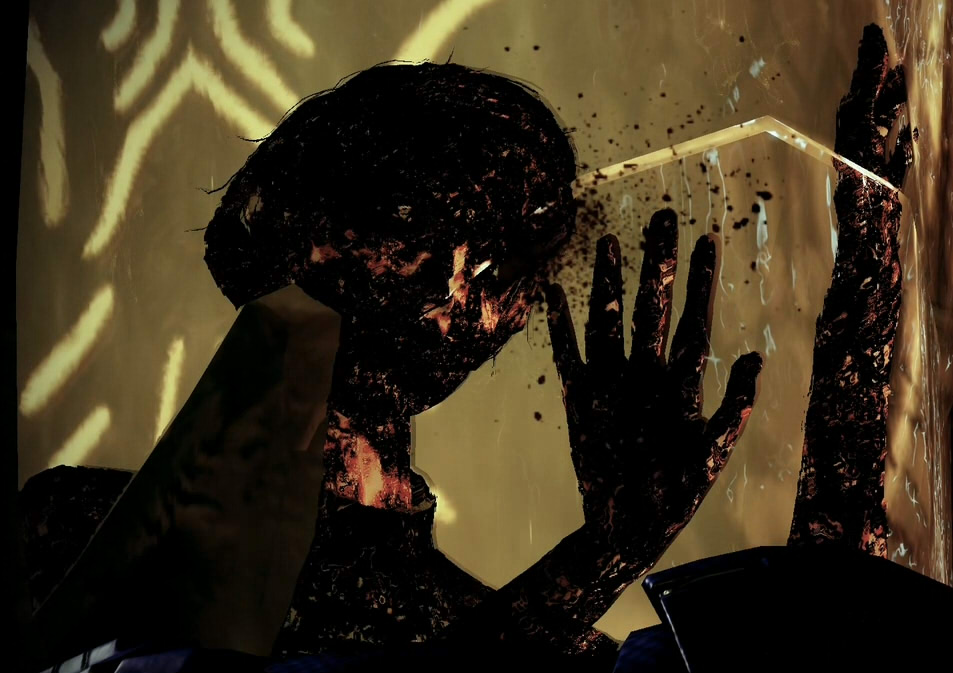
Take for example, Mass Effect 2. Towards the endgame the player's shipmates are kidnapped by an alien force. The player is then given a choice which seems fairly harmless-- save their crew immediately or take time to prepare before embarking on the rescue mission. Not until the player finally decides to give chase to the alien kidnappers do the repercussions of their decision come into play. Depending on how long the player waits before saving the crew the player will be treated to a cutscene during the rescue mission. If the player left immediately after the kidnapping they are treated to a scene where they successfully save them from death. However, if they decided to wait, they will be forced to watch their crew die as the protagonist fruitlessly tries to save them.


The reason I find this an excellent example is that the consequences are not spelt out directly for the player. While it is implied that abandoning them temporarily could be bad, as well as being immoral, it isn't explicitly stated-- it purely comes down to the gut feeling of the player. The weight of their action is not discovered until much later in their playthrough when they finally embark on the mission. During this time they may have developed other plotlines making it harder for the player to sacrifice all their effort made in the meantime in order to revert their save and erase their regrets. Not only that, but there is also risk in recklessly giving chase. Unless the player was organised enough to be fully-prepared for the venture, the result could end up jeopardising the lives of the player's companions that join the mission. Therefore the question asked when you make your choice can essentially be boiled down to: "Should I place my crew at risk or my companions?". By framing such an important question as "leave now or prepare first" the weight of the choice is disguised without being dishonest. This allows the player to answer truthfully based on their own volition and without influence, giving the game an opportunity to truly dissect the player.

Most important of all however, is that there is a lasting impact based on the outcome. For the rest of the game, if the crew dies they will be absent from the spacecraft.  For example, your ship's yeoman-- and potential love interest-- is dead and gone forever. You can't ever speak to her again. Conversely, if one of your companions dies, their room will now sit eerily empty, permanently. You may have saved the galaxy but you couldn't save those who helped you reach that goal. There is a distinct emptiness, a twinge, in the otherwise gleaming tale. The hero isn't perfect, they were human like the rest of us. And that's what makes the story so much more memorable.

28.4.17

Synthesising Gameplay and Narrative: A Look into Papers Please and Undertale

As voiced in my previous post, I feel like most games fail to take advantage of the medium of video games. However, I fail to mention any games that break away from this mainstream approach of linear storytelling. While such games are infrequently produced and therefore harder to come across, there are two noteworthy instances in recent years where such a game has managed to capture the attention of a wider audience, mostly due to their blurring of gameplay and story. These games are of course 'Papers Please' by Lucas Pope and 'Undertale' by Toby Fox.


These games, released two years apart, also share some other properties: both were made (for the most part) by a single person, on small budgets with even smaller fanbases. I predict that such an environment led to their riskier, experimental designs becoming much more appealing and viable.

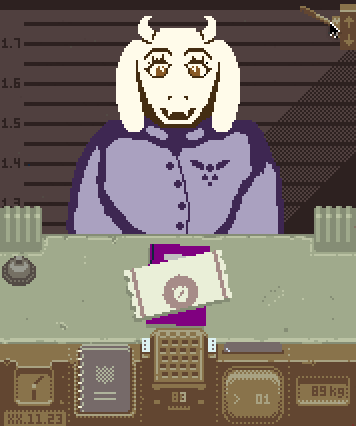
In 'Papers Please' the player takes on the role of a border control officer in charge of checking travel documentation of denizens attempting to enter the country of Arstotzka, a fictional authoritarian Eastern-bloc country, during the height of the Cold War. The player's role is simple: allow all those with valid passports and documents through and reject all else. Each immigrant will deal with you differently: some will act civil, some will beg and bribe, others will pass by without a word. Their livelihoods are left entirely within your hands-- your decision may ultimately lead to their demise. While the player has the ability to disregard immigration procedure for whichever case they are swayed by, there are consequences which could leave the protagonist's own job and family in jeopardy.


'Undertale' on the other hand tells the heart-warming story of a child on his quest to return to his home after falling into an alternate world filled with "monsters". It is structured similarly to your standard turn-based RPG with linear wandering sections peppered with dialogue and turn-based battles. These combat segments are what make Undertale stand out from the crowd. Unlike standard RPGs where attacks are based purely on statistics, avoiding attacks here involves avoiding projectiles in 'bullet hell' mini games. More interestingly however is the consequences of such excursions. While the player can kill all enemies encountered they can also use 'mercy' to spare any and every opponent, meaning that the entire story can be completed without killing a single creature. This has a massive effect on the atmosphere of the world during the player's journey as inhabitants will react to the choices made during these fights-- if a character's friends have been killed by the player their opinion of them will be gravely diminished. Regardless, it is left up to the player how to tackle these fights, whatever the circumstance.


So what exactly is it that these two games do in common? To put it simply, the gameplay cannot be separated from the story because it is the story. In Paper's Please, the story is your daily interactions with travellers and how you decide to deal with them. Undertale is the story of how you choose to make friends, rivalries, victims and enemies of the residents of the world that you find yourself trapped in. In both cases, it is impossible to tell the narrative without the gameplay-- the plot is inextricably woven into it. By synthesising these elements, the player's relationship to the story is enhanced as they become an agent within the narrative itself-- actions players make within the environment can be commented on and reacted to, with the player subsequently reacting to these changes. A conversation is formed. Here, the player does not need to roleplay to fit the mould of whatever the story requests: they can simply play themselves and see how the world reacts to it.

Papers Please could be considered a 'purer' form of this design as all gameplay choices weave directly into the narrative. Undertale on the other hand sticks more closely to the traditional approach as combat is the sole component that affects narrative-- the wandering and chatting to locals in between these segments is still linear. Now this does not mean that these components are unnecessary. Under-utilised perhaps, but certainly not a waste. These elements are still required to set the atmosphere and tone and develop the characters of the world. Without these moments, the emotional investment would suffer during these combat sections. However, I do feel that the ideas Toby Fox can communicate solely through Undertale's combat mechanics are too restricted due to the system's simplistic nature: you can only kill or save. This leads to a situation where the outcomes of the story are a bit too clean cut: you are either exalted as a saint for saving everyone, vilified as a vile murderer for killing everyone, or utterly forgettable for anything in between. In this regard I feel that Papers Please has a greater level of nuance as it blurs the lines between all options with the breadth of its conclusions. On top of this, the player's ability to fulfil their job also affects the outcome. The added pressure of having a family to protect and feed means that it is simply not good enough to have good intentions, you must also have the ability to attain it. So few games, even those who games brag about having deep, hard-hitting storylines fail to achieve this.

With other games, the notion of stripping gameplay from narrative is much, much easier. Even looking at games that are praised for their narrative such as 'Mass Effect' or 'Uncharted', gameplay has a minimal effect on the plot's outcome or even the themes the game is trying to communicate. For example, if all the lasers and gunning was removed from Mass Effect how does the story change? Can the story still be told? Apart from a slight shift away from an action-filled tale, nothing has changed-- no matter how many (or how few) aliens and robots you blast on your journey, you will still be able to save the universe and you'll still be the hero. Perhaps some love interests may have gotten away, some comrades slain, but in the end no one cares. You will have the same cutscene as everyone else. The universe will be at peace. Now it might be unfair to bully the Mass Effect franchise especially since I would call it a fun game but I find it incredibly disheartening when it is considered one the best narrative experiences to be found in video games.

Now, one possible reason for this absence of choice is the lack of time for developers to implement a vast network of possible paths. As is, it seems like game developers in large studios are already overworked, so the idea of devoting any more time may simply be impossible. However, I don't think this is the underlying issue. After all, both Papers Please and Undertale were made largely by individuals. In fact, I would argue that the reason it seems so impossible for large studios to achieve something similar is because they have too many people. With such a large body of staff, it seems as if those working on story and those working on gameplay are separated into two different teams. If both these aspects are made independently with little to no communication it would be impossible for their parts to harmonise as neatly as works by individuals such as Pope or Fox. However, it is also impossible for these small indies to create games of similar technical detail as those of larger studios so any shift in these bigger companies seems unlikely. Therefore, such a style of game may only be possible within the hands of small development teams. However, if indie games with similar design patterns to Undertale and Papers Please continue to rise to prominence maybe we will see a focus by the industry, as a whole, towards these styles.