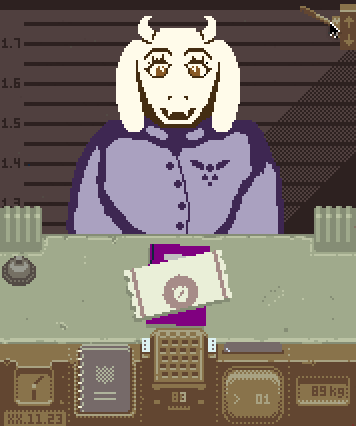
These games, released two years apart, also share some other properties: both were made (for the most part) by a single person, on small budgets with even smaller fanbases. I predict that such an environment led to their riskier, experimental designs becoming much more appealing and viable.
In 'Papers Please' the player takes on the role of a border control officer in charge of checking travel documentation of denizens attempting to enter the country of Arstotzka, a fictional authoritarian Eastern-bloc country, during the height of the Cold War. The player's role is simple: allow all those with valid passports and documents through and reject all else. Each immigrant will deal with you differently: some will act civil, some will beg and bribe, others will pass by without a word. Their livelihoods are left entirely within your hands-- your decision may ultimately lead to their demise. While the player has the ability to disregard immigration procedure for whichever case they are swayed by, there are consequences which could leave the protagonist's own job and family in jeopardy.

'Undertale' on the other hand tells the heart-warming story of a child on his quest to return to his home after falling into an alternate world filled with "monsters". It is structured similarly to your standard turn-based RPG with linear wandering sections peppered with dialogue and turn-based battles. These combat segments are what make Undertale stand out from the crowd. Unlike standard RPGs where attacks are based purely on statistics, avoiding attacks here involves avoiding projectiles in 'bullet hell' mini games. More interestingly however is the consequences of such excursions. While the player can kill all enemies encountered they can also use 'mercy' to spare any and every opponent, meaning that the entire story can be completed without killing a single creature. This has a massive effect on the atmosphere of the world during the player's journey as inhabitants will react to the choices made during these fights-- if a character's friends have been killed by the player their opinion of them will be gravely diminished. Regardless, it is left up to the player how to tackle these fights, whatever the circumstance.
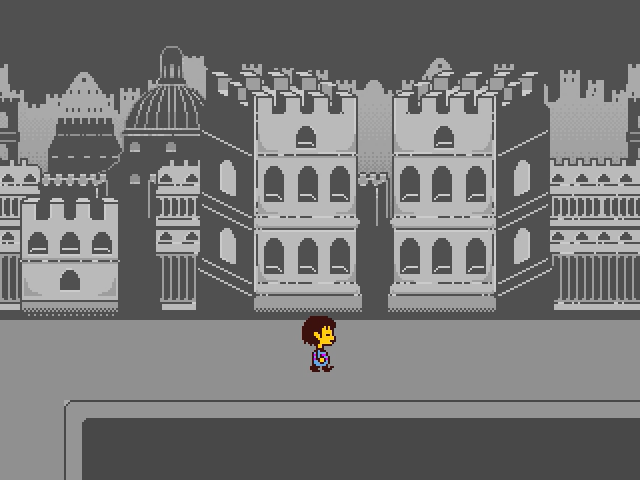
So what exactly is it that these two games do in common? To put it simply, the gameplay cannot be separated from the story because it is the story. In Paper's Please, the story is your daily interactions with travellers and how you decide to deal with them. Undertale is the story of how you choose to make friends, rivalries, victims and enemies of the residents of the world that you find yourself trapped in. In both cases, it is impossible to tell the narrative without the gameplay-- the plot is inextricably woven into it. By synthesising these elements, the player's relationship to the story is enhanced as they become an agent within the narrative itself-- actions players make within the environment can be commented on and reacted to, with the player subsequently reacting to these changes. A conversation is formed. Here, the player does not need to roleplay to fit the mould of whatever the story requests: they can simply play themselves and see how the world reacts to it.
Papers Please could be considered a 'purer' form of this design as all gameplay choices weave directly into the narrative. Undertale on the other hand sticks more closely to the traditional approach as combat is the sole component that affects narrative-- the wandering and chatting to locals in between these segments is still linear. Now this does not mean that these components are unnecessary. Under-utilised perhaps, but certainly not a waste. These elements are still required to set the atmosphere and tone and develop the characters of the world. Without these moments, the emotional investment would suffer during these combat sections. However, I do feel that the ideas Toby Fox can communicate solely through Undertale's combat mechanics are too restricted due to the system's simplistic nature: you can only kill or save. This leads to a situation where the outcomes of the story are a bit too clean cut: you are either exalted as a saint for saving everyone, vilified as a vile murderer for killing everyone, or utterly forgettable for anything in between. In this regard I feel that Papers Please has a greater level of nuance as it blurs the lines between all options with the breadth of its conclusions. On top of this, the player's ability to fulfil their job also affects the outcome. The added pressure of having a family to protect and feed means that it is simply not good enough to have good intentions, you must also have the ability to attain it. So few games, even those who games brag about having deep, hard-hitting storylines fail to achieve this.
With other games, the notion of stripping gameplay from narrative is much, much easier. Even looking at games that are praised for their narrative such as 'Mass Effect' or 'Uncharted', gameplay has a minimal effect on the plot's outcome or even the themes the game is trying to communicate. For example, if all the lasers and gunning was removed from Mass Effect how does the story change? Can the story still be told? Apart from a slight shift away from an action-filled tale, nothing has changed-- no matter how many (or how few) aliens and robots you blast on your journey, you will still be able to save the universe and you'll still be the hero. Perhaps some love interests may have gotten away, some comrades slain, but in the end no one cares. You will have the same cutscene as everyone else. The universe will be at peace. Now it might be unfair to bully the Mass Effect franchise especially since I would call it a fun game but I find it incredibly disheartening when it is considered one the best narrative experiences to be found in video games.
Now, one possible reason for this absence of choice is the lack of time for developers to implement a vast network of possible paths. As is, it seems like game developers in large studios are already overworked, so the idea of devoting any more time may simply be impossible. However, I don't think this is the underlying issue. After all, both Papers Please and Undertale were made largely by individuals. In fact, I would argue that the reason it seems so impossible for large studios to achieve something similar is because they have too many people. With such a large body of staff, it seems as if those working on story and those working on gameplay are separated into two different teams. If both these aspects are made independently with little to no communication it would be impossible for their parts to harmonise as neatly as works by individuals such as Pope or Fox. However, it is also impossible for these small indies to create games of similar technical detail as those of larger studios so any shift in these bigger companies seems unlikely. Therefore, such a style of game may only be possible within the hands of small development teams. However, if indie games with similar design patterns to Undertale and Papers Please continue to rise to prominence maybe we will see a focus by the industry, as a whole, towards these styles.

